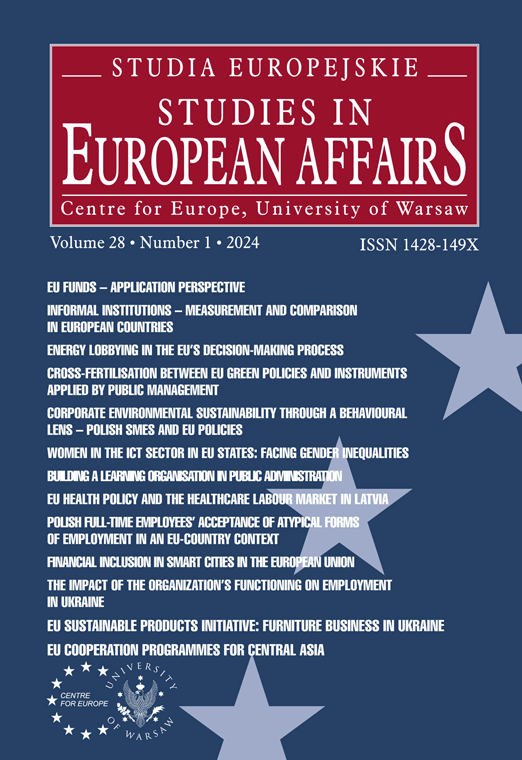
Issue: 4/2025
- Volume 29
- Number 4
- 2025
Subscribe NEWSLETTER
Studia Europejskie –
Studies in European Affairs
ISSN: 1428-149X
e-ISSN: 2719-3780

License
Articles published in the journal are under a Creative Commons Attribution – Non Commercial – No Derivatives 4.0 International License

Publication co-financed by Ministry of Science and Higher Education pursuant to the Regulation of the Minister of Education and Science of 3 August 2021 (Journal of Laws of 2021, item 1514) on the “Development of Scientific Journals” programme.
Publikacja dofinansowana przez Ministerstwo Nauki i Szkolnictwa Wyższego na podstawie rozporządzenia Ministra Edukacji i Nauki z 3 sierpnia 2021 r. (Dz. U. z 2021 r. poz. 1514) w sprawie programu „Rozwój czasopism naukowych”.

Publication co-financed by the University of Warsaw within the “Excellence Initiative – Research University” programme.
Czasopismo otrzymało dofinasowanie w ramach Programu „Inicjatywa Doskonałości – Uczelnia Badawcza”.
Call for Papers
Issue 1/2026
“Studia Europejskie – Studies in European Affairs”, no. 1/2026
We invite you to submit texts for the next issue of the scientific quarterly “Studia Europejskie – Studies in European Affairs” no. 1/2026. This edition will focus on the topic:
European Energy and Ecological Transition: Political, Economic, Social, and Ethical Dimensions
The thematic scope is intentionally broad. We welcome both theoretical and empirical contributions addressing the political, economic, social, normative, and international aspects of energy transition. Topics of interest include, but are not limited to:
- energy security and environmental security,
- the European Green Deal,
- energy transition and governance,
- energy and climate policies,
- sustainable development,
- economic competitiveness,
- transformations in industry, agriculture, and transport.
Contributions exploring international, regional, or local dimensions of these phenomena are especially encouraged. However, given the profile of the journal, each submission should include a clear European perspective (not necessarily limited to the EU).
PAPERS’ SUBMISSION:
Prospective authors are requested to submit their papers to the Editors at: journalse@uw.edu.pl
FORMATTING REQUIREMENTS AVAILABLE AT:
https://journalse.com/wp-content/uploads/2022/11/styleguideharvard2023-A.pdf
TIMELINE:
Submission deadline: 20/11/2025
Review: 15/01/2026
Publication: 30/03/2026
Issue 2/2026
“Studia Europejskie – Studies in European Affairs”, no. 2/2026
We invite you to submit texts for the next issue of the scientific quarterly Studia Europejskie – Studies in European Affairs (no. 2/2026). This edition will be primarily dedicated to the topic:
Peace and Stability in the Balkans: 30 Years after the Dayton Agreement
but submissions on other topics related to European affairs are also welcome.
The 30th anniversary of the Dayton Agreement provides an important opportunity to reflect on the achievements and challenges of post-conflict reconstruction in the Balkans. We encourage contributions that examine political, social, economic, and security developments in the region, as well as the broader implications for European stability and integration.
PAPERS’ SUBMISSION:
Prospective authors are requested to submit their papers to the Editors at: journalse@uw.edu.pl
FORMATTING REQUIREMENTS AVAILABLE AT:
https://journalse.com/wp-content/uploads/2022/11/styleguideharvard2023-A.pdf
TIMELINE:
Submission deadline: 15/01/2026
Review: 15/03/2026
Publication: 30/06/2026
Issue 3/2026
“Studia Europejskie – Studies in European Affairs”, no. 3/2026
We invite scholars and researchers to submit their manuscripts for the upcoming thematic issue of Studia Europejskie – Studies in European Affairs (no. 3/2026), devoted to the topic:
Differentiated Integration in Europe: Challenges, Dynamics, and Future Prospects
Over the past decades, differentiated integration has become one of the defining features of the European Union’s evolution. Faced with growing diversity among member states, varying political ambitions, and complex global challenges, the EU has increasingly relied on flexible forms of cooperation. This issue aims to explore the theoretical and practical dimensions of differentiated integration—its drivers, mechanisms, and implications for the future of European governance.
We welcome contributions addressing, among others:
- conceptual and normative debates on differentiated integration;
- case studies of sectoral or institutional differentiation;
- implications for EU unity, legitimacy, and democracy;
- internal risks and challenges to the cohesion and effectiveness of the European Union;
- comparative or interdisciplinary perspectives on flexible integration.
Submissions on related topics within European studies are also welcome.
PAPERS’ SUBMISSION:
Prospective authors are requested to submit their papers to the Editors at: journalse@uw.edu.pl
FORMATTING REQUIREMENTS AVAILABLE AT:
https://journalse.com/wp-content/uploads/2022/11/styleguideharvard2023-A.pdf
TIMELINE:
Submission deadline: 28/02/2026
Review: 29/05/2026
Publication: 30/09/2026